S&P500 Daily Action Areas & Price Targets 18/11/26

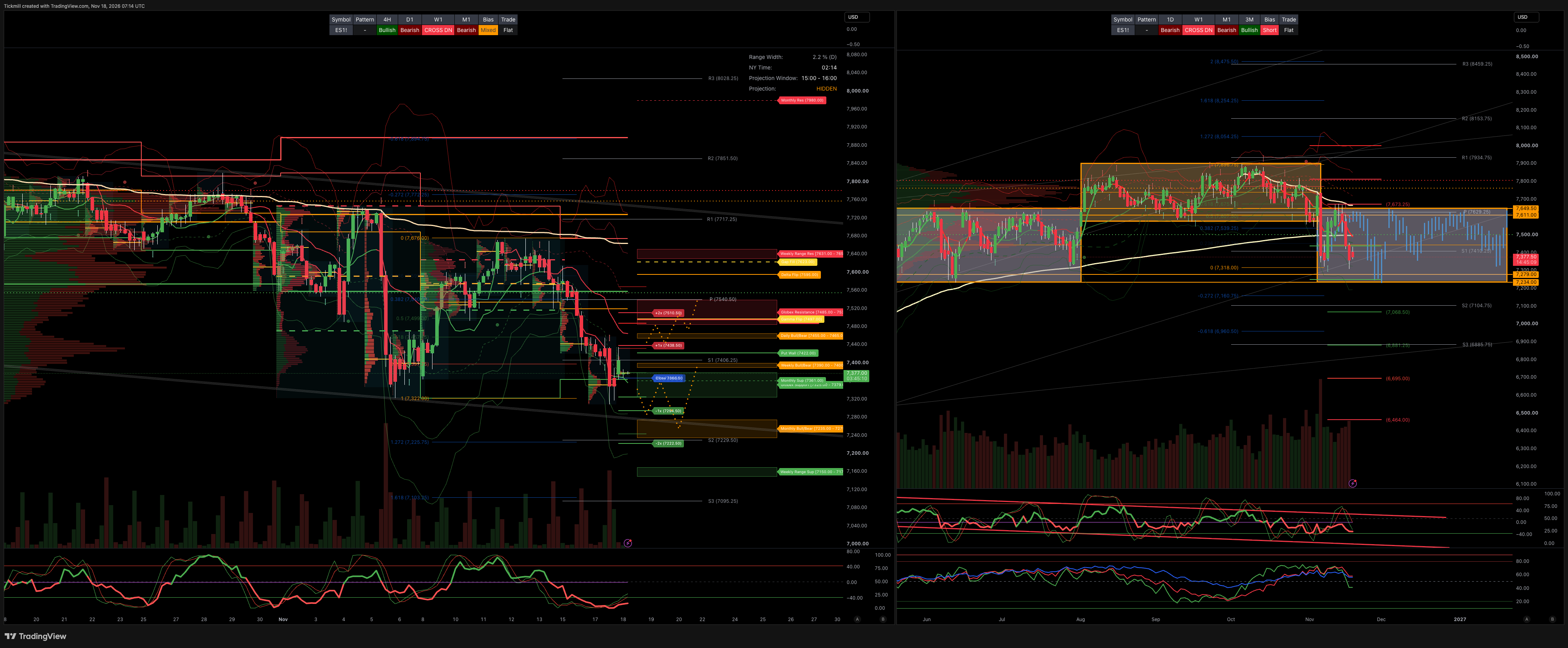
S&P500 Daily Action Areas & Price Targets 18/11/26
***QUOTING ES1!(Z CONTRACT LEVLES) FOR CASH US500 EQUIVALENT LEVELS, SUBTRACT POINT DIFFERENCE***
VIX EXPIRATION
MONTHLY-WEEKLY& DAILY LEVELS
MONTHLY BULL BEAR ZONE 7275/35
MONTHLY RANGE RES 7980 SUP 7361
WEEKLY BULL BEAR ZONE 7400/7390
WEEKLY RANGE RES 7631/51 SUP 7170/50
DAILY BULL BEAR ZONE 7455/65
GLOBEX RANGE SUP 7270/7194 RES 7421/94
GAMMA FLIP 7461
DELTA FLIP 7511
CALL WALLS 7446/76
PUT WALLS 7395/68
DAILY STRUCTURE - OTFL - 7437
WEEKLY STRUCTURE - OTFL - 7674
MONTHLY STRUCTURE - TBC
VIX BULL BEAR ZONE 18.72
VVIX-to-VIX ratio, currently hovering at approximately 4.76,falls within the historically typical range of 4.0 to 6.0. This suggests that volatility expectations are in a neutral zone, reflecting neither panic nor extreme contrarian sentiments.
PRIMARY TRADES & TARGETS
LONG ON REJECT/RECLAIM MBBZ TARGET RTH CLOSE>WBBZ
***ADDITIONAL SETUPS & TARGETS HIGHLIGHTED ON THE CHARTS***
(I FADE TESTS OF 2 SIGMA LEVELS ESPECIALLY INTO THE FINAL HOUR OF THE NY CASH SESSION AS 90% OF THE TIME WHEN TESTED THE MARKET WILL CLOSE ABOVE OR BELOW THESE LEVELS)
SPX PUT/CALL RATIO 1.29 (The numbers reflect options traded during the current session.) A put-call ratio below 0.7 is generally considered bullish, and a put-call ratio above 1.0 is generally considered bearish.
JHEQX Upside cap (~7,920–7,950): Dealer gamma hedging at this call strike creates resistance, with market makers likely selling futures into strength and limiting volatility. Downside cushion (~7,270): If SPX drops 5% into Q4, long put gamma may force dealers to buy futures as the index falls, helping stabilize prices. Expiration: December 31, 2026. Strong pinning effects are likely near key strikes into year-end expiration.
DEC2025 OPEX to DEC2026 OPEX is 945 points giving us a range of [5889,7779]
Notes On Structure Implications
Balance: This refers to a market condition where prices move within a defined range, reflecting uncertainty as participants await further market-generated information. Our approach to balance includes favouring fade trades at the range extremes (highs/lows) while preparing for potential breakout scenarios if the balance shifts.
One-Time Framing Higher (OTFH): This represents a market trend where each successive bar forms a higher low, signalling a strong and consistent upward movement.
One-Time Framing Lower (OTFL): This describes a market trend where each successive bar forms a lower high, indicating a pronounced and steady downward movement.
GOLDMAN SACHS FICC & EQUITY TRADING DESK VIEWS
US EQUITIES & DERIVATIVES BRIEFING: SPX BREACHES 200-DMA ON CYBER HEADLINES BEFORE NVDA EARNINGS BEAT & $150B BUYBACK BOOST
US equities traded broadly heavier on Tuesday, with the S&P 500 dropping -1.03% to close at 7,340—slipping decisively below its 200-day moving average (7,344)—while the Russell 2000 fell -1.39% to 2,703 and the Dow shed -1.64% to 50,759. Intraday weakness was triggered by firmer US Retail Sales (reinforcing higher-for-longer Fed pricing) and an afternoon risk-off leg spurred by headlines surrounding potential cyber incidents (later clarified by the NSA as network outages tied to routine software updates).
In technology, the Nasdaq-100 held remarkably resilient (-0.07% to 27,001) ahead of Nvidia’s pivotal after-hours report. Following the bell, Nvidia (NVDA) traded +3% after hours on a strong fiscal Q3 beat ($115.8B revenue vs. ~$109.3B consensus) and Q4 guidance (~$130B vs. ~$125.2B consensus), paired with an additional $150B share repurchase authorization (bringing total remaining buyback capacity to ~$227.3B through FY28). Simultaneously, Board Chair Harvey Jones opened the earnings call by explicitly stating the Board does not plan to reinstate Jensen Huang as CEO, formalizing the transition under Interim CEO Colette Kress.
CROSS-ASSET BENCHMARK DASHBOARD
S&P 500 (SPX): Closed at 7,340.00 (-1.03%) | Breached 200-DMA (7,344) | MOC $2.4B to SELL | VIX jumped +10.61% to 25.34 | Next-day straddle: 1.26%
Nasdaq-100 (NDX): Closed at 27,001.00 (-0.07%) | Outperformed broader indices by nearly 100 bps ahead of NVDA print
Russell 2000 (RUT): Closed at 2,703.00 (-1.39%) | Pressured by firm retail sales and 5.10% 10-Year yields
Dow Jones (DJI): Closed at 50,759.00 (-1.64%) | Lagged on cyclical and consumer weakness
Consolidated Tape Volume: 18.855B shares traded across US exchanges (vs. 18.557B YTD daily average)
US 10-Year Treasury Yield: Down -2 bps to 5.10% | Holding above the 5.00% psychological threshold
WTI Crude: Flat +1 bp to $85.73/bbl | Consolidating around mid-$85 levels
Gold: Down -0.19% to $3,849.00/oz | Hovering near technical support
US Dollar Index (DXY): Down -5 bps to 103.50 | Pausing after recent breakout
Bitcoin: Down -1.96% to $63,988.00 | Extending pullback below $64,000
TECH REGULATORY HEADWINDS, FLOOR FLOWS & SINGLE-STOCK MOVERS
Three-Front Tech Regulatory & Governance Overhang:
Tightened China AI Chip Access: New regulatory proposals aimed at closing loopholes—specifically preventing Chinese firms from renting Nvidia compute capacity outside the US or acquiring processors through third-party countries.
Chinese Data Center Hardware Ban: Reuters reported the Trump administration plans to press ahead with blocking US imports of Chinese-manufactured data center equipment.
Nvidia Board Oversight Committee: Nvidia established a dedicated board committee specifically tasked with overseeing national security and export-control compliance.
Institutional Floor Flows (3/10 Activity):
Cash desk activity was notably quiet ahead of the event risk.
Asset Managers (LOs): Finished as net sellers, led by continued supply in mega-cap technology.
Hedge Funds (HFs): Finished roughly balanced, maintaining neutral directional exposure.
Consumer Spotlight — Nike (
NKE) Investor Day Reversal:Desks saw heavy two-way activity in Nike (
NKE), which reversed sharply from early gains (+3%) to close down -6% during its Investor Day as institutional investors expressed deep skepticism toward management's 2031 financial guidance.
DERIVATIVES SURFACE: VOL EXPIRY & NVDA EVENT CLEARING
Intraday Volatility Spike & Skew Relaxation:
Early in the session, implied volatility and skew drifted lower despite moderately red spot action. The afternoon cyber-scare sell-off triggered an immediate jolt higher, pushing front-end
NDXandSPXfixed-strike vols up greater than 1.0 vol by the close.However, put skew relaxed meaningfully into the afternoon, leaving only the belly of the
SPXvolatility curve with a modest bid.
Post-Event Volatility Compression Setup:
Between Tuesday's close and Wednesday's open, the market clears both Nvidia earnings and monthly VIX expiration.
The derivatives desk expects clearing these twin catalysts to drain substantial event-vol premium from the surface—especially as dealer short-tail gamma rolls off—causing cross-asset risk parameters to relax.
Institutional Options Flows:
VIX Downside Spread: A Goldman Sachs client bought 14,000 contracts of the VIX 16Dec 19/16 Put Spread, positioning for implied volatility normalization into year-end.
SPX Term Structure: Clients actively sold front-end
SPXvolatility against back months, expressing the view that front-end implied vols had become overly rich relative to medium-term term structure.Next-Day Implied Move: The S&P 500 straddle through Wednesday's close is priced at +/- 1.26%.
Disclaimer: The material provided is for information purposes only and should not be considered as investment advice. The views, information, or opinions expressed in the text belong solely to the author, and not to the author’s employer, organization, committee or other group or individual or company.
Past performance is not indicative of future results.
High Risk Warning: CFDs are complex instruments and come with a high risk of losing money rapidly due to leverage. 68% and 74% of retail investor accounts lose money when trading CFDs with Tickmill UK Ltd and Tickmill Europe Ltd respectively. You should consider whether you understand how CFDs work and whether you can afford to take the high risk of losing your money.
Futures and Options: Trading futures and options on margin carries a high degree of risk and may result in losses exceeding your initial investment. These products are not suitable for all investors. Ensure you fully understand the risks and take appropriate care to manage your risk.
Patrick has been involved in the financial markets for well over a decade as a self-educated professional trader and money manager. Flitting between the roles of market commentator, analyst and mentor, Patrick has improved the technical skills and psychological stance of literally hundreds of traders – coaching them to become savvy market operators!